
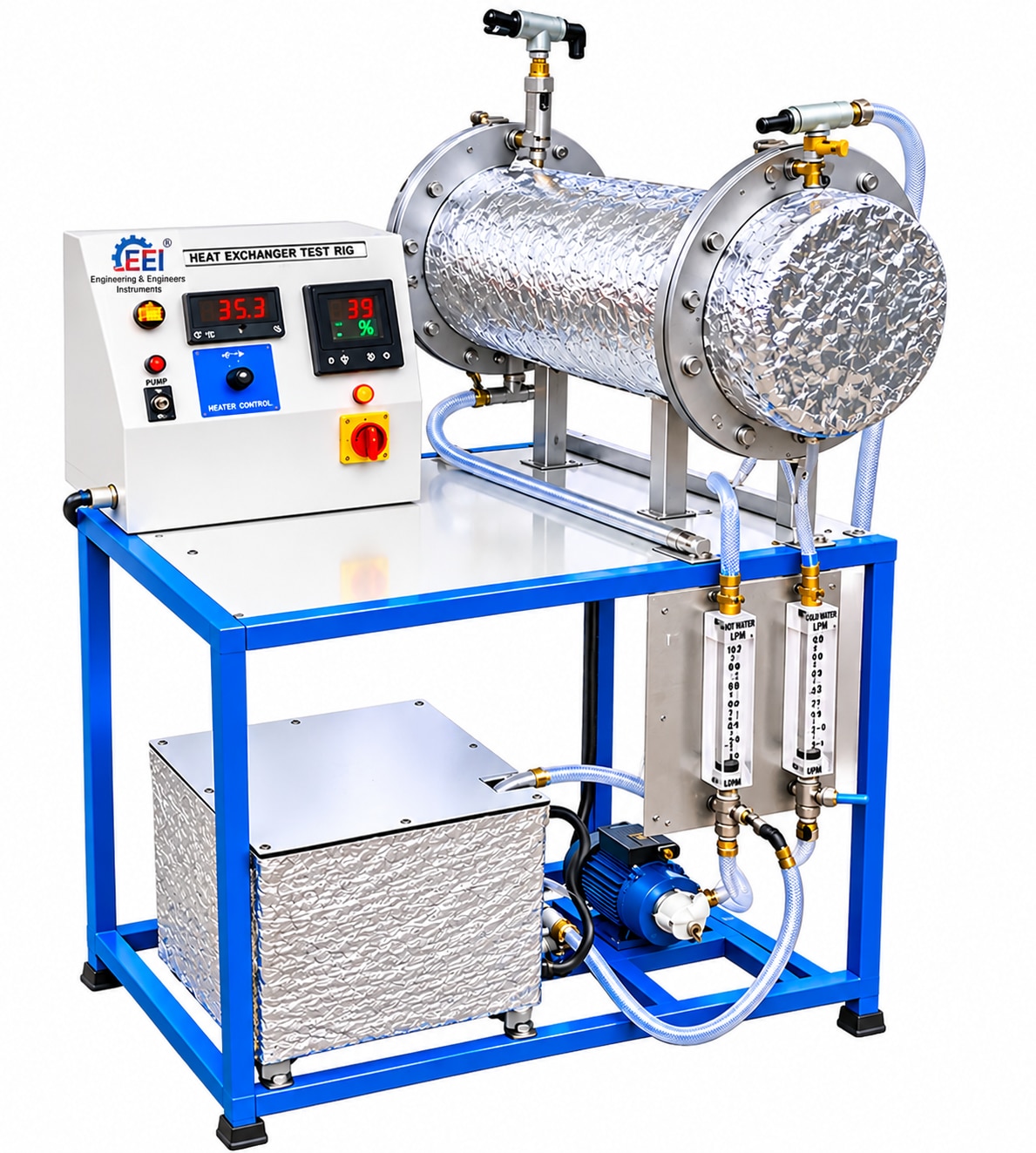
Shell and Tube Heat Exchanger
Description
The Shell and Tube Heat Exchanger is a laboratory apparatus designed to study heat transfer between two fluids flowing through separate passages. The equipment demonstrates the principles of heat exchange, temperature variation, heat transfer rate, and the effect of fluid flow arrangements on thermal performance.
The unit consists of a shell housing a bundle of tubes through which one fluid flows, while the other fluid circulates through the shell surrounding the tubes. The arrangement facilitates heat transfer between the hot and cold fluids without direct mixing. The apparatus is suitable for conducting experiments under parallel-flow and counter-flow conditions.
The test rig is equipped with temperature measurement instruments, flow measurement devices, circulation pumps, control valves, piping connections, and a control panel for monitoring and regulating operating conditions. The insulated heat exchanger minimizes heat losses to the surroundings and improves experimental accuracy.
Designed for engineering colleges, polytechnic institutes, ITIs, and thermal engineering laboratories, the apparatus provides hands-on training in heat exchanger operation, thermal analysis, and heat transfer performance evaluation.
Features
Demonstration of heat transfer between two fluids.
Shell-and-tube heat exchanger construction.
Separate flow paths for hot and cold fluids.
Parallel-flow and counter-flow operation.
Temperature measurement at inlet and outlet locations.
Flow rate measurement for both fluid circuits.
Circulation pumps and flow control valves.
Insulated heat exchanger for reducing heat losses.
Control panel for monitoring and operating the system.
Sturdy laboratory frame with integrated piping arrangement.
Experiments
Study of heat transfer in a shell and tube heat exchanger.
Performance comparison between parallel-flow and counter-flow arrangements.
Determination of heat transfer rate.
Calculation of logarithmic mean temperature difference (LMTD).
Determination of overall heat transfer coefficient.
Study of the effect of fluid flow rate on heat exchanger performance.
Energy balance between hot and cold fluid circuits.