
Composite Wall Apparatus
Description
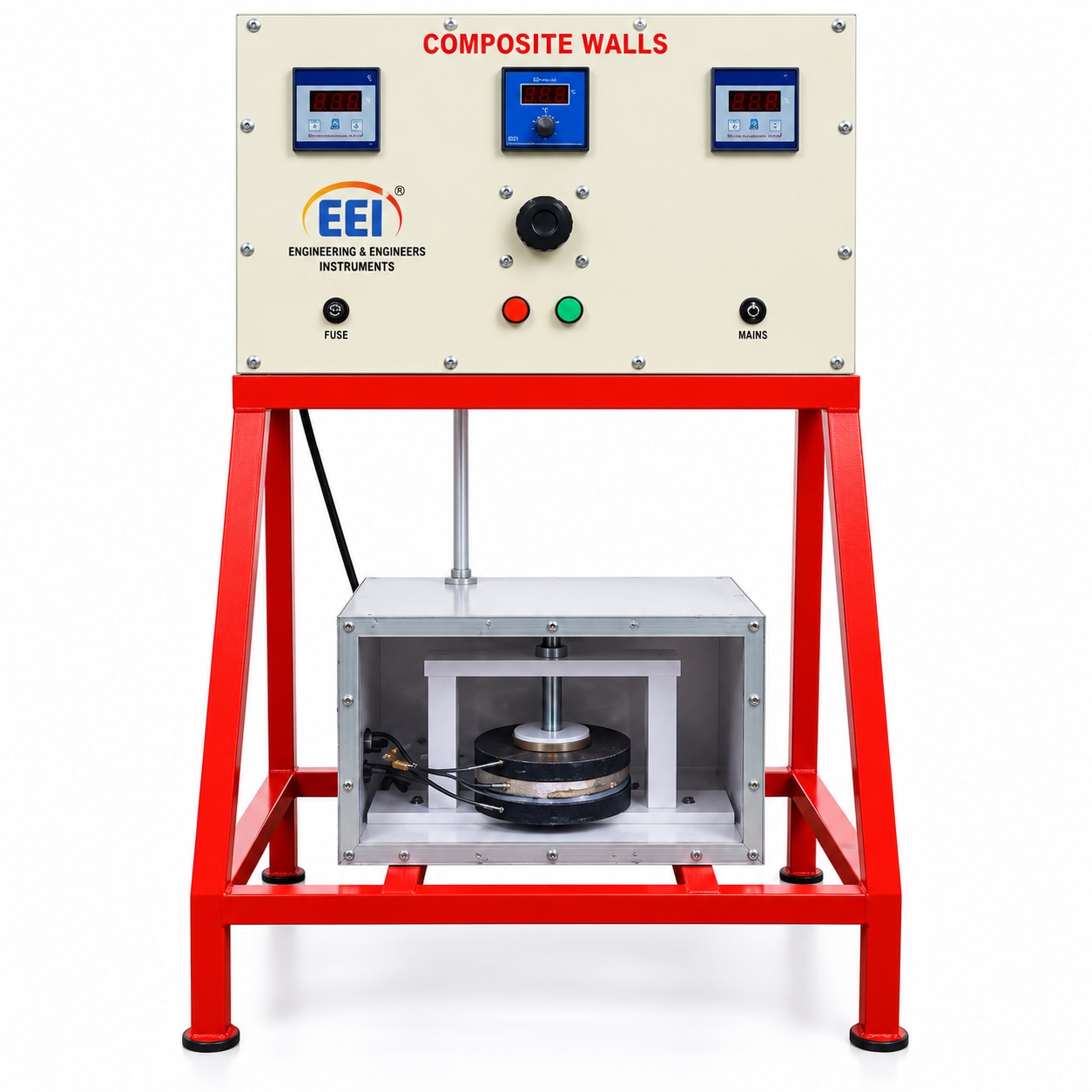
The Composite Wall Apparatus is a laboratory training unit designed to study heat conduction through composite materials arranged in series. It demonstrates the principles of thermal resistance, heat transfer through multiple layers, temperature distribution across different materials, and the effect of material properties on heat conduction.
The apparatus consists of a composite wall assembly made from different materials, an electrical heating arrangement to provide controlled heat input, cooling arrangement on the opposite side, and temperature sensors positioned at different locations across the wall. The temperature readings enable students to observe the temperature gradient across individual layers and investigate the thermal resistance of the composite structure.
The unit is equipped with a digital temperature indicator, heater control, thermocouples, insulation, and a control panel for monitoring and regulating experimental conditions. The apparatus enables practical determination of thermal conductivity and overall thermal resistance of composite walls.
It is suitable for engineering colleges, polytechnic institutes, ITIs, and heat transfer laboratories for conducting experiments related to steady-state heat conduction through composite materials.
Features
Study of heat conduction through composite walls.
Multiple materials arranged in series.
Controlled electrical heating arrangement.
Temperature measurement at different wall interfaces.
Digital temperature indication.
Heater input control.
Insulated test section to minimize heat losses.
Demonstration of thermal resistance of individual layers.
Compact tabletop laboratory arrangement.
Suitable for thermal engineering education and research.
Experiments
Study of steady-state heat conduction through a composite wall.
Determination of temperature distribution across different wall layers.
Calculation of thermal resistance of individual materials.
Determination of overall thermal resistance of the composite wall.
Estimation of thermal conductivity of different materials.
Study of the effect of material thickness on heat transfer.
Verification of the thermal resistance concept for composite walls.