
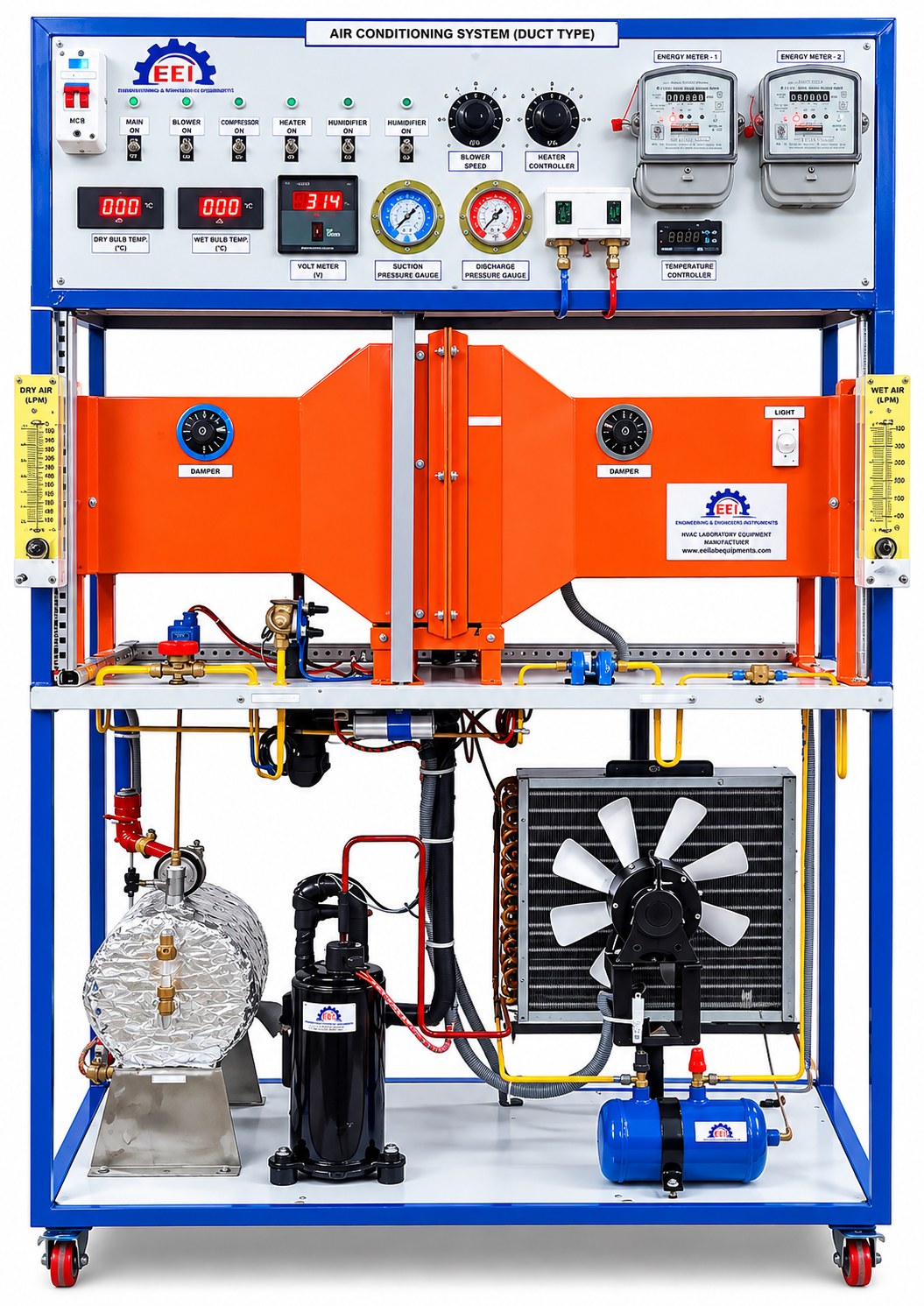
Air Conditioning System Trainer (Duct Type)
Description
Make: EEI, Model: RAC-08, Origin: India
Product Overview
The Air Conditioning System (Duct Type) is an educational and experimental laboratory apparatus designed to demonstrate the principles of air conditioning, air distribution, temperature and humidity control, and refrigeration system operation. It is suitable for mechanical engineering colleges, ITIs, polytechnic institutes, HVAC laboratories, and technical training centres.
The system consists of a duct-type air handling section, refrigeration circuit, compressor, heat exchanger, blower, dampers, airflow measuring devices, and an integrated instrumentation panel. The apparatus is mounted on a sturdy MS frame with a blue-painted finish, providing convenient access to the system components for laboratory demonstrations and practical experiments.
The unit enables students to study air movement through ducts, monitor dry-bulb and wet-bulb temperatures, observe pressure conditions, and measure electrical energy consumption during system operation.
Working Principle
The duct-type air-conditioning system works by conditioning air as it passes through a duct and heat-exchange arrangement. A blower circulates air through the duct section, while the refrigeration system provides cooling through its evaporator. Depending on the installed configuration, heating and humidification components can be used to demonstrate changes in air temperature and moisture content.
Dampers regulate airflow, and the measuring instruments allow students to observe changes in air conditions at different operating points. Dry-bulb and wet-bulb temperature measurements can be used to study relative humidity and psychrometric properties when suitable measurement procedures and charts are available.
The compressor circulates refrigerant through the refrigeration circuit, while the condenser rejects heat to the surroundings. Together, these components demonstrate the relationship between air conditioning, heat transfer, refrigeration, and energy consumption.
Main Features
• Duct-type air-conditioning training and experimental setup.
• Integrated air duct with adjustable dampers.
• Blower arrangement for air circulation.
• Refrigeration compressor and heat-exchange assembly.
• Dry-bulb and wet-bulb temperature measurement.
• Dry-air and wet-air flow measurement devices, as fitted.
• Suction and discharge pressure gauges.
• Digital voltage, current, and temperature indicators.
• Electrical energy meters for monitoring energy consumption.
• Blower speed and operating controls.
• Air-conditioning duct and refrigeration piping arrangement.
• Sturdy MS frame for laboratory use.
• Suitable for demonstrations, performance studies, and HVAC practical training.
System Components and Their Functions
. Air Duct Assembly: Provides a passage for air circulation and supports the study of air conditioning and airflow behaviour.
2. Blower: Circulates air through the duct and air-conditioning section.
3. Dampers: Regulate airflow through the duct and allow investigation of different airflow conditions.
4. Dry-Bulb Temperature Measuring Device: Measures the air temperature without considering its moisture content.
5. Wet-Bulb Temperature Measuring Device: Supports humidity and psychrometric studies when used with the appropriate measurement procedure.
6. Airflow Measuring Devices: Indicate airflow through the dry-air and wet-air measuring sections, depending on the installed configuration.
7. Refrigeration Compressor: Compresses low-pressure refrigerant vapour and circulates refrigerant through the refrigeration circuit.
8. Evaporator / Cooling Coil: Absorbs heat from the air passing through the air-conditioning section.
9. Condenser Coil: Rejects heat from the refrigerant to the surrounding air.
10. Condenser Fan: Assists heat rejection from the condenser coil.
11. Refrigerant Piping: Connects the main refrigeration components and carries refrigerant through the system.
12. Refrigerant Flow-Control Device: Reduces refrigerant pressure before it enters the evaporator.
13. Suction Pressure Gauge: Indicates refrigerant pressure on the low-pressure side.
14. Discharge Pressure Gauge: Indicates refrigerant pressure on the high-pressure side.
15. Digital Voltage Meter: Measures electrical supply voltage.
16. Digital Current Meter: Measures electrical current drawn by the equipment.
17. Temperature Controller / Indicator: Displays temperature readings or provides temperature control, depending on the fitted instrument.
18. Energy Meters: Monitor electrical energy consumption of the connected circuits.
19. Electrical Control Panel: Houses switches, indicators, controls, and measuring instruments for operating and monitoring the system.
20. MS Support Frame: Supports the duct assembly, refrigeration equipment, instrumentation, and associated piping.